Rewriting the Future of Rehabilitation
Gamified, Brain-Smart Therapy for Children with Cerebral Palsy
For many children with cerebral palsy (CP), therapy is both essential and exhausting.
They practice the same hand movements and repeat words and sentences over and over. Sessions are often scheduled in different clinics for different problems: speech in one place, arm and hand in another. The work is important, but it can feel endless, fragmented, and—by the children’s own description—boring.
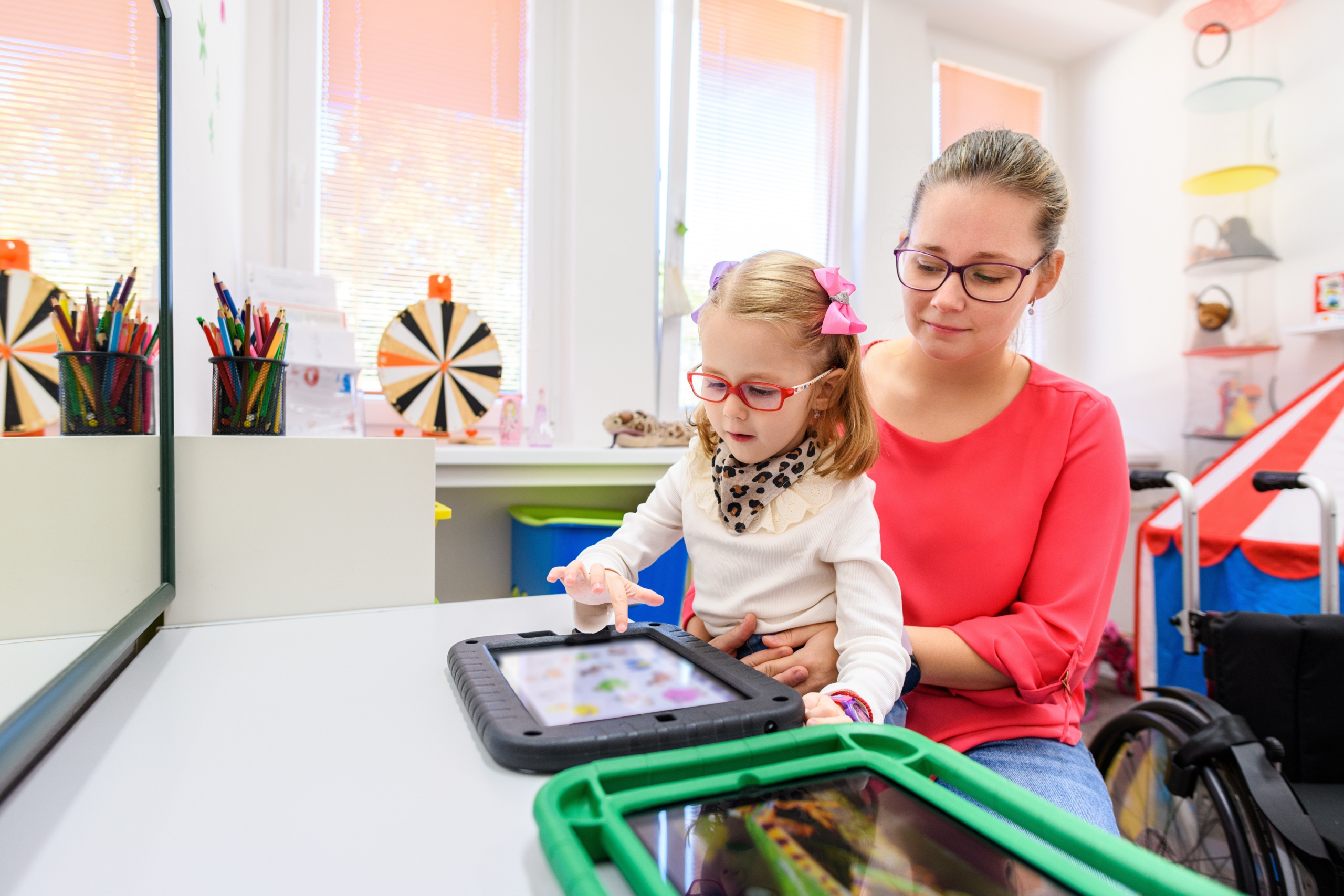 At Rutgers School of Health Professions, a team of researchers is testing a different future for rehabilitation. They are building a therapy disguised as a game that simultaneously targets speech and arm function that aligns with the developing brain.
When moving and speaking are both hard
CP is the leading cause of motor impairment in children.1 Many children with CP have difficulty controlling one or both arms. Many also have a motor speech disorder called dysarthria, which makes their speech sound slurred or effortful.
Michelle Chang, Ph.D., an assistant professor in the Department of Rehabilitation and Movement Sciences, reminded the audience what that sounds like in real life. She played a sample of a sentence—“the blue spot is on the key”—spoken by a child with severe dysarthria. To most listeners, it was almost impossible to understand. “That is what we call severely unintelligible speech,” she said.
These challenges stack. A child might rely on a walker or wheelchair, struggle to grasp a cup, and struggle to make themselves understood. That combination limits independence and chips away at confidence in everyday settings like school, playgrounds, and home.
There is strong evidence that intensive, repetitive therapy can help both speech and motor skills.2 But as Chang pointed out, the way traditional therapy is delivered makes it hard to sustain. Long and repetitive sessions can quickly feel tedious. “When you put children through an intensive treatment, it’s really hard for them to continue into therapy and finish that treatment,” she noted. Children themselves describe it as “really boring.”
Care is also fragmented. Many children with CP receive speech therapy in one clinic and arm or hand therapy in another, often with little coordination between the two. Yet from a neurological perspective, speech and arm movements are closely linked. We gesture while we talk, and we reach as we describe. The brain networks for speech and upper-limb control overlap.
This disconnect—between how children live and how their brains are wired, on one hand, and how services are delivered, on the other—is what the Rutgers team set out to address.
Turning therapy into a space mission
Chang’s group is developing what they call SPACE: the Speech and Arm Combined Exergame. It’s a narrative-driven, eight-week therapy program built to feel like a space adventure.
In the game, the child is an astronaut exploring a series of planets. Each planet represents a therapy week. Each day on that planet, they complete a set of missions that are, beneath the surface, carefully designed speech and upper-limb tasks.
On some missions, words appear on the screen, and the child repeats them using a “big mouth” and strong voice. Practicing loud, clear speech improves intelligibility. On others, those words progress to sentences. In more advanced levels, the child looks at a picture, describes it in their own words, and uses their more-affected hand to grab and drag the image to the correct place on the screen.
The same content can be played in three modes: voice only, arm only, or voice plus arm together. This allows the team to compare what happens when therapy focuses on one system at a time versus when it trains together.
The space theme was thoughtfully selected to make the intensity of the work tolerable. Motor speech and upper-limb treatment still need repetition and effort. The game is designed to wrap that effort into a story, rewards, and visual feedback that keeps a child engaged long enough for the therapy to do its job.
At its core, the design is multidisciplinary. Chang works alongside physical therapist and movement scientist Jigna Patel, Ph.D., engineer Qinyin Qiu, Ph.D., and student developer at the New Jersey Institute of Technology. Together they probed word lists, sentence complexity, and hand movements to match clinical goals for children with CP.
Chang put it simply: “If we gamify treatment, we may be able to maximize engagement during therapy helping to ensure that the treatment is both effective and sustainable.”
Watching the brain work during play
While the game took shape, Soha Saleh, Ph.D., an assistant professor in the Department of Rehabilitation and Movement Sciences, was focusing on a different layer: the brain activity that accompanies all those tasks.
Saleh has long been interested in how motor and speech networks intersect. Standing in front of the audience, she pointed out something everyone in the room was doing without thinking: “Did you notice how much we use our hands as we’re speaking?” she said. “That makes sense why speech and motor tasks go together.”
In adults, neuroimaging studies have already shown that regions involved in speech production and those involved in hand movements overlap.3 Structures classically associated with language light up during finger movements; motor regions activate during speech. Yet very little of that work has been done in children, and even less with tasks that resemble real-world therapy.
Using an electroencephalogram (EEG), Saleh recorded brain activity from the typically developing children while they played the SPACE tasks. She focused on sensors over frontal regions associated with speech (Broca’s area) and over the motor cortex region controlling the hand.
Children completed blocks of voice-only, arm-only[MK1.1], and combined tasks. Each trial allowed a short window—two seconds—for the child to execute the movement or speech; slow responses[MK2.1] were counted as failed attempts.
The preliminary results show distinct but connected patterns. During voice-only tasks, frontal speech areas show a burst of activity just before and during speech. During upper-limb only[MK3.1][GU3.2] tasks, the motor cortex shows the expected changes in rhythms associated with movement, with some activity spilling into premotor and frontal regions.
When both voice and arm tasks are combined, the timing and distribution shift. Saleh’s early interpretation is that the brain appears to plan the verbal component first, with motor regions carrying more of the load once the movement starts. In some frequency bands, speech-related areas show slightly reduced activity compared with voice-only tasks, while motor regions remain strongly engaged.
She summarized the takeaway this way: the data “support the verbal motor integration and the idea that they integrate distinct and distributed neural networks.” In other words, speech and hand movements aren’t just happening side by side; they are sharing and processing overlapping brain networks.
This matters for rehabilitation design. If a combined task pulls too heavily on shared resources, a child might unconsciously trade off speech clarity for movement quality, or vice versa. If it hits the right balance, training both together could reinforce those shared networks more efficiently than training each system in isolation.
The EEG work gives the team a way to see where on that spectrum a given task sits, and to adjust the game accordingly.
Letting kids respond before the data
Before enrolling children with CP into the full study, the team ran a feasibility phase. Twelve typically developing children and two children with CP came into the lab for a single session. They completed standard speech and arm assessments, wore EEG caps to record brain activity, and then played the SPACE game in voice-only, arm-only, and combined modes.
At the end, they filled out a short survey. Did they like the game? Was it easy or hard? Could they imagine playing it every day? Did they feel it helped their hand and voice?
Typically developing children rated the game highly. They described it as fun, easy to understand, and visually appealing. That told the team the basic concept worked.
The two children with CP offered more pointed feedback. They liked the idea and found much of the game engaging, but the combined mode—especially the level that required speaking, wrist movement, and dragging images to precise locations—was difficult enough to lower their ratings.
The team took that seriously, and they adjusted camera placement and motion-tracking settings so that the combined tasks remained demanding but did not depend on movements that were beyond what the children with CP could realistically do. That revision is ongoing as they prepare for the treatment phase.
Ultimately, the children’s feedback is influencing the development of the tool as much as the outcome measures.
Looking ahead: more than a clever game
The study itself is still early. The team plans to recruit fifteen children with CP and assign them to three conditions: speech-focused training, upper-limb-focused training, and the combined SPACE condition. All children will be assessed at three time points: before therapy, immediately after the eight-week program, and again six weeks later to evaluate which improvements are maintained.
The hope is that children in the combined, gamified condition will show greater improvements in speech intelligibility, social communication, and arm and hand function than children who train those skills separately. The EEG data will help explain why.
Even at this stage, the direction is clear.
Rehabilitation here is not just “more therapy.” It is therapy redesigned to match how children’s brains and daily lives are organized—where speaking and moving are intertwined, where sustained effort needs a story to hold it, and where children’s input help shape the tools built for them.
It is also a model of how Rutgers School of Health Professions approaches rehabilitation research more broadly: multidisciplinary teams, careful attention to both behavior and brain, and a willingness to let the people at the center of the work—the children themselves—have a say in their therapy.
References:
- CDC. 2024. “About Cerebral Palsy.” Cerebral Palsy (CP). May 14, 2024. https://www.cdc.gov/cerebral-palsy/about/index.html.
- Klevberg, Gunvor L., Manuela Zucknick, Reidun Jahnsen, and Ann-Christin Eliasson. 2023. “Development of Hand Use with and without Intensive Training among Children with Unilateral Cerebral Palsy in Scandinavia.” Developmental Neurorehabilitation, March, 1–9. https://doi.org/10.1080/17518423.2023.2193256.
- Xu, Jiang, Patrick J. Gannon, Karen Emmorey, Jason F. Smith, and Allen R. Braun. 2009. “Symbolic Gestures and Spoken Language Are Processed by a Common Neural System.” Proceedings of the National Academy of Sciences 106 (49): 20664–69. https://doi.org/10.1073/pnas.0909197106.