Listening First: How Rutgers SHP is Redesigning Care With Communities
When systems are designed far from the people who use them, even good intentions can land badly.
- An autistic adult’s pain is dismissed as just behavior.
- A bilingual child is routed into special education because a test wasn’t built for them.
- An older woman leaves the free clinic unsure whether she can repeat the exercises at home, wishing her sessions were longer.
- A young man with a spinal cord injury leaves rehab, but is unprepared for daily routines.
- A health sciences student stands in line for groceries on a campus built for future health leaders.
Research points to better ways of working. The gap is between what we know on paper and what people live every day.
At Rutgers School of Health Professions (SHP), a group of faculty are tackling that gap through community engagement that is more than a slogan. Across autism care, public schools, free clinics, spinal cord injury rehabilitation, and food security, they are doing the same quiet, difficult thing: they listen first, share the design work, and let community feedback direct what they do..
From evidence on paper to lives in exam rooms
Occupational Therapist and Researcher Aaron Dallman, Ph.D., O.T./L., is blunt about the stakes for autistic people.
Autistic individuals, Dallman notes, are far more likely to die prematurely than non-autistic peers often from things we know how to prevent: missed epilepsy diagnoses, untreated depression, late cancer screening, and chronic pain that never gets taken seriously. These failures often stem from diagnostic overshadowing, a bias that leads healthcare providers to assume new symptoms are simply part of a person’s disability rather than signs of another condition.1 Families describe struggling to find primary-care providers who understand their children. Autistic adults of color face even steeper barriers to timely diagnoses of treatable conditions and preventive care.
“This is preventable,” Dallman told colleagues. “We have the blueprints to fix this; we need to start building.”
The problem is how long it takes to filter science into everyday practice, and how often it arrives stripped of the values of the people it is meant to help. Many autistic self-advocates talk about wanting neurodiversity-affirming care—care that accepts autistic neurology, focuses on support and access, honoring natural traits, and providing the right tools for everyone to thrive.
Dallman’s response has been to work on where evidence and experience collide: the exam room, and the provider’s habits inside it.
Instead of designing a tool in isolation to measure good practice, he and his collaborators developed a survey of neurodiversity-affirming care with autistic adults, family members, and healthcare professionals. Community members helped decide which attitudes and behaviors mattered most. Autistic clinicians piloted the survey while thinking aloud through their reactions.
That process changed the instrument. It includes items about whether providers see distressing behaviors as just who the person is or as responses to overwhelming environments. It asks how useful clinicians find labels like high functioning and low functioning, which many autistic people experience as stigmatizing. It probes both what providers do and how they think.
The data are already being used to tailor training that show up in the formats clinicians say they actually use: short infographics in team huddles, brief recorded webinars, concise guides that can sit beside the electronic health record. The goal is to move everyday practice closer to what autistic people themselves describe as affirming, without adding more to clinicians’ already crowded days.
It’s a pattern that repeats across SHP’s work: communities help define what the problem is and what “better” looks like, and then that definition drives change.
When a school district asks for help and stays at the table
In Newark’s public schools, the question was different but the feeling was similar: something in the system wasn’t working the way people hoped.
Referrals for special education and speech–language services had surged. Case loads climbed. Contract evaluators were brought in to meet deadlines. Leaders in the Office of Special Education worried about the strain, but also about equity – particularly for children who grow up with more than one language.
National data show that students from historically marginalized communities are at higher risk of being labeled as having language disorders when the real issue may be bias in tools or expectations.2 In Newark, a district where most students are Black or Hispanic and many live in bilingual homes, that risk is a reality.
Speech–Language Pathologist (SLP) and SHP Faculty Member Kristen Victorino, Ph.D., arrived with an open mind. The project began when district leaders said, in effect, “We’re seeing this wave of referrals. We’re concerned. Can we figure out what’s going on, together?”
From there, her team and the district used community-based participatory research principles to uncover the problem. They reviewed charts. They convened focus groups with district SLPs, contract evaluators, and child study team members. They compared how different groups saw the same process.
Two themes emerged. First, once children were referred, they were very likely to be classified – a sign that the threshold for referral itself might be too low. Second, multilingual students were often assessed using standardized tests that were not normalized for their backgrounds, and limited documentation of their full range of languages.
The focus groups revealed a more human nuance too. District SLPs tended to see evaluations as one part of a child’s longer story in the school system. Many contract evaluators, working under tight timelines and productivity targets, described their role as producing a report and moving on.
Out of that shared analysis came shared action. The team didn’t simply write recommendations; they built new roles. Four district speech-language specialists now serve as liaisons between Rutgers and their school wards. They helped select more appropriate assessment tools, co-developed lesson plans, and shaped a new evaluation protocol that will guide child study teams. Contract evaluators are being folded into the change through video modules on multilingual assessment and documentation.
“It’s one thing for a researcher to say, ‘Here’s what I think you should do,’” Victorino told the symposium. “As opposed to going in and working with the district on, first of all, coming up with what their concerns are – that’s really where this all came from.”
The work is slow. It has to contend with state regulations, staffing shortages, and the day-to-day urgencies of a large urban district. But it is also building something durable: a relationship where data and lived experience sit at the same table.
Listening inside the clinic walls
The same shift – from “for” to “with” – is happening inside SHP’s own walls.
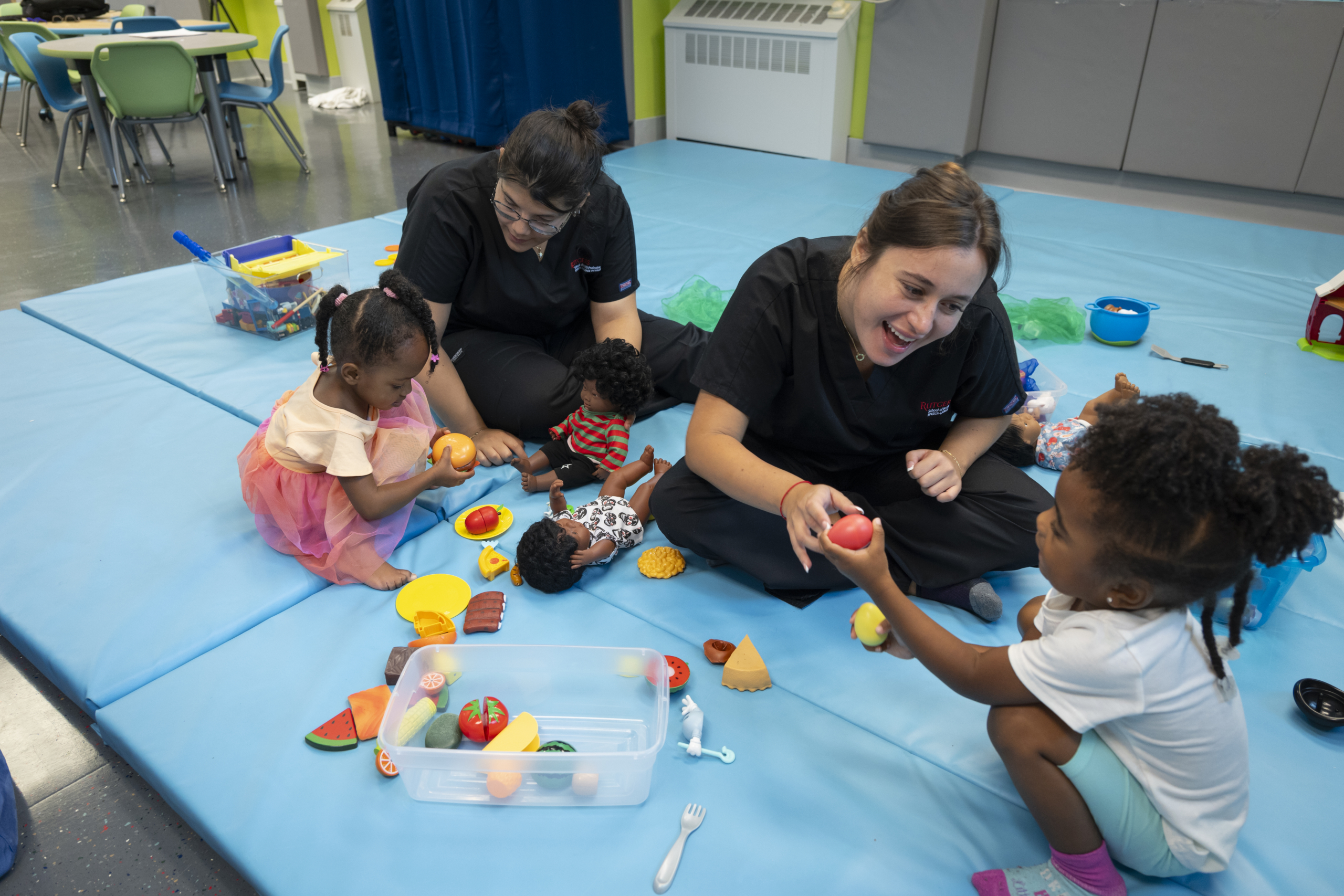 On the seventh floor of the Stanley S. Bergen Building, the Speech-Language Pathology Clinic serves as both a student training site and a lifeline for the community. Graduate students, supervised by licensed clinicians, provide free therapy in person and via telehealth. In a single year, they delivered more than 6,500 hours of pro bono care.
For a long time, that care flowed in one direction. Faculty knew students met accreditation standards and that the clinic was busy. What they did not know, in any systematic way, was how clients and families experienced the services.
When Program Director Celeste Domsch, Ph.D., went looking for research on client satisfaction in university speech clinics, she found almost nothing in recent decades. “Our students are trained in our clinic, and our patients receive services,” she reflected, “and no one asks the patients what they think about the services.”
She and Clinical Education Director Stephanie Hubbell, M.S., set out to change that. Working with their advisory committee, they created a 24-question satisfaction survey that used a simple emoji scale to make responding easy, especially for families completing it on their phones.
Questions covered the warmth and clarity of communication, whether services were offered in a preferred language, clients’ confidence in student clinicians, and whether people saw real improvement.
Early on, clinic staff handed clients iPads and watched as they answered – a well-intended move that risked polite, overly positive responses. The team adjusted quickly, switching to QR codes to strengthen privacy measures. The response rate stayed high, and the answers became more useful.
Clients described the clinic as welcoming and professional. They noticed that students and supervisors listened. They appreciated the option to receive services in Spanish or Portuguese, and the presence of decorations and resources that signaled the space was meant for them. They also named what could be better: more therapy sessions, longer visits, additional locations, clearer home-practice materials, and greater confidence in the skills of students early in their training.
Those comments are now steering real changes. Group programs are being expanded where they make sense, so more people can be seen without diluting quality. Families leave with home exercise programs when semesters end, instead of facing long gaps with no guidance. Physical space has been rearranged to ease crowding. Feedback about student communication skills has fed directly into classroom teaching and new simulations that let students practice difficult clinical conversations.
The clinic is still a training site, but it is now also a place where community voices have a structured way to shape what training means.
Extending patient care beyond discharge
One of the clearest tests of community engagement is whether it extends beyond the immediate program and into the rest of someone’s life.
For young adults with spinal cord injuries, the path from hospital to whatever comes next is often broken. Rehabilitation is short. Schools and workplaces may not know how to accommodate them. Families are left improvising.
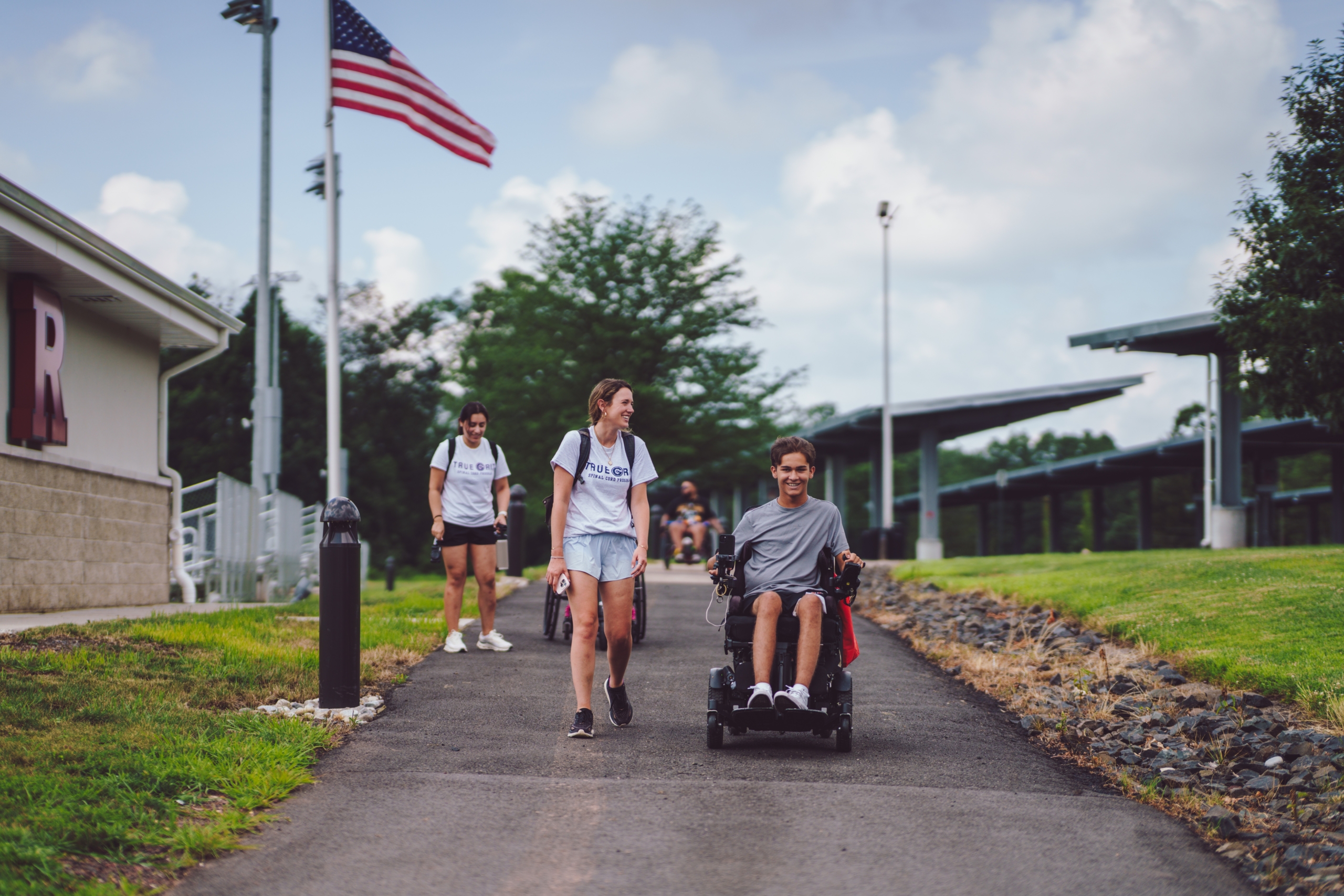 The True Grit residential program, a collaboration between Rutgers and Children’s Specialized Hospital, was created to fill part of that gap. Each summer, a small group of 16- to 21-year-olds with spinal cord injuries spends a week living in dorms, navigating a college campus, and participating in daily therapy, peer mentorship, psychological support, and vocational exploration.
When Occupational Therapist and Doctoral Researcher Keara McNair, M.O.T., O.T.R./L., evaluated the program, she wanted to know more than whether participants enjoyed the week. She tracked their independence and progress toward personal goals. She interviewed them and their families. She asked staff and student volunteers what it felt like from their side.
With such a small cohort, McNair did not expect dramatic statistical shifts. Yet over that single week, participants showed measurable gains in self-care and daily routines: dressing, transfers, bowel and bladder management. Every participant achieved or exceeded their primary goal for the week. Interviews revealed something the numbers alone could not fully capture: a sense of belonging, of being seen as young men planning futures rather than as patients.
Every participant achieved or exceeded their primary goal for the week. Interviews revealed something the numbers alone could not fully capture: a sense of belonging, of being seen as young men planning futures rather than as patients.
Families described watching their children try tasks they had assumed were out of reach. Students from SHP – occupational therapy, physical therapy, counseling, and other programs – spoke about the emotional intensity of the week and the depth of learning that came from working as one-to-one attendants and members of an interprofessional team.
Those stories are now shaping the next version of True Grit. The program is expanding from a single week to a year-round arc, with monthly debriefs for participants, groups for families, and structured ways to revisit transition goals. McNair and her collaborators are building formal referral pathways with health systems and national spinal cord organizations, so that more young people even hear about the program in time to benefit.
It is a small program in terms of numbers. But it is a clear example of how SHP projects do not stop at good week, good data. They ask what it would take for the gains to matter in the long run, and they adjust accordingly.
Seeing food access as part of health, not an afterthought
Community engagement at SHP is not limited to formal health care encounters. It also shows up in how the school responds when basic needs are at risk.
When Nutritional Epidemiologist Joachim Sackey, Ph.D., set out to understand food insecurity on the Rutgers Health campus, he already knew from national research that college students are more likely than the general population to struggle with consistent access to food. Still, the numbers from the pantry’s survey were stark: nearly four in ten respondents – students and staff combined – were food insecure.
Many of them were doing everything society tends to frame as solutions: taking out loans and working full- or part-time while running up against rising costs and limited time—not a lack of effort.
Sackey favors the United Nations’ definition of food security: stable physical and socioeconomic access to sufficient, safe, and nutritious food that meets people’s preferences.3 By that standard, needing to queue publicly for groceries on a campus plaza is more than an inconvenience.
“If people have to acquire food in undesirable, potentially humiliating ways, like lining up,” he told colleagues, “that’s a sign of being food insecure.”
The survey asked not just whether people struggled, but how. Respondents asked for more fresh produce and protein, more halal and culturally familiar options, longer hours, better communication, and ways to access food that felt less exposed.
The pantry team has treated that feedback as a roadmap. Hours have expanded beyond a single day. An online ordering system now allows users to filter for vegan, gluten-free, halal, or kosher items when those are available. Pop-up distributions on the plaza bring food closer to where people already are, paired with things like hot chocolate or a borrowed ping-pong table to make the space feel more like a commons than a charity line.
Alongside the groceries, new efforts in budgeting support, cooking demonstrations, and even a professional clothing closet are beginning to respond to what people described: that food insecurity rarely comes alone.
The work is practical: unloading thousands of pounds of food each week, recruiting volunteers, tagging inventory. Underneath that, it is also about dignity. The pantry’s standing invitation is simple: if someone needs food, they are welcome, no explanation required.
Why this kind of engagement matters
Taken one by one, these projects might look unrelated: autism care, school speech evaluations, a university clinic, a spinal cord injury camp, a campus pantry.
Seen together, they trace a consistent shift in how Rutgers SHP approaches its role.
Instead of assuming what people need, faculty are asking. Instead of treating community input as a checkbox, they are building it into how problems are defined, how programs are designed, and how success is measured. Instead of delivering services to communities, they are learning how to build, test, and revise solutions with them.
That doesn’t erase the structural challenges—underfunded schools, biased systems, limited resources, the long lag between research and routine practice—but it changes the posture.
When an autistic adult helps decide what affirming care means, a clinician’s training can shift. When Newark educators co-design assessment protocols, multilingual children have a better chance at fair evaluations. When clients in a free clinic say what works and what doesn’t, student learning and service delivery both improve. When young adults with spinal cord injuries and their families show what a week of support can do, programs can follow them further into adulthood. When students and staff describe how it feels to stand in line for food, pantries can evolve into something less stigmatizing.
That is what advances in community engagement looks like here: not a separate initiative, but a way of closing the distance between evidence and everyday life, one conversation, one partnership, and one redesign at a time.
References:
- Hallyburton, Ann. 2022. “Diagnostic Overshadowing: An Evolutionary Concept Analysis on the Misattribution of Physical Symptoms to Pre‐Existing Psychological Illnesses.” International Journal of Mental Health Nursing 31 (6). https://doi.org/10.1111/inm.13034.
- Irwin, V., Wang, K., Jung, J., Kessler, E., Tezil, T., Alhassani, S., Filbey, A., Dilig, R., Mann, F. B., Barnett, M., Purcell, S., & Nachazel, T. (2024). Report on the condition of education 2024.
- “Food Security – What It Means and Why It Matters | World Food Programme,” UN World Food Programme (WFP), July 7, 2025, https://www.wfp.org/stories/food-security-what-it-means-and-why-it-matters.