Rutgers Expands Leadership in Interprofessional Education Through Innovative Greece Exchange
Rutgers School of Health Professions (SHP) is pushing interprofessional education (IPE) to the forefront of health professions training with a new international program in Greece that brought Rutgers and Greek students together to study how communication, teamwork, and health systems differ across borders—and critically, how those differences might matter for patient safety.
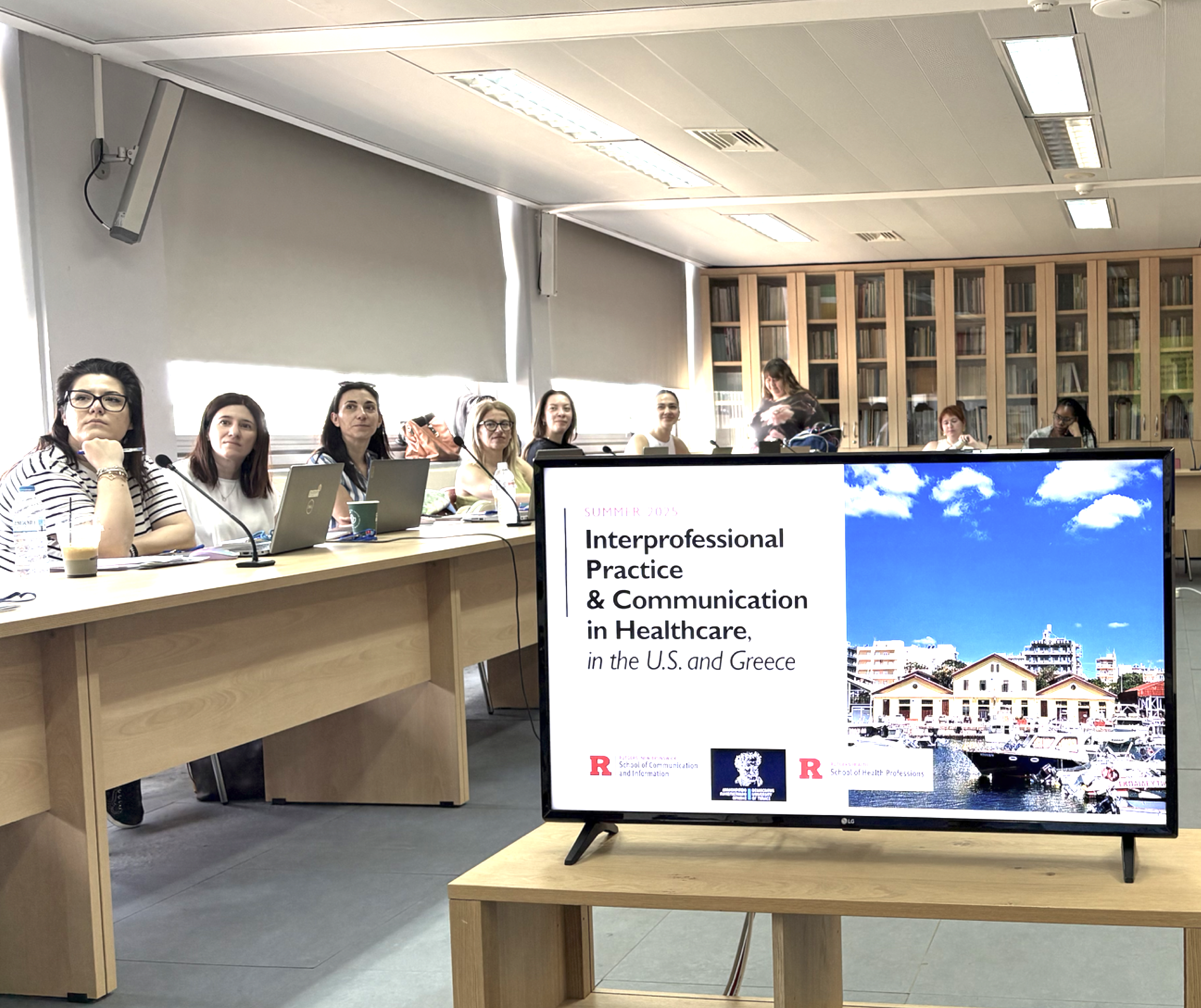 The summer initiative, led by faculty from SHP, the School of Communication and Information, and the Ernest Mario School of Pharmacy, offered a glimpse into how countries approach collaboration in healthcare. For Rutgers, the goal is to cement the university as a national and global leader in IPE education and practice.
To its Greek partners, Rutgers faculty introduced practical models of interprofessional practice—not just as classroom theory but as daily behaviors: giving feedback across disciplines, navigating hierarchy, and speaking up to prevent harm. For Rutgers students, Greece offered lessons of its own.
Following the country’s 2008 financial crisis and a mass exodus of physicians, Greece reinvented parts of its health system. Community pharmacists unexpectedly became frontline primary-care providers. “We saw real innovation born out of necessity,” said Scott Parrott, professor in interdisciplinary studies. “Students witnessed how a system with fewer physicians adapted by expanding roles in ways the U.S. can learn from.”
 A visit to Greek community pharmacies offered students a look at how pharmacists can serve as frontline clinicians. During the visit, a boy who had fallen off his bike walked in for help, and “the head pharmacist came around, did a physical exam, fixed him up… and sent him on his way, ” said Dipali Yeh, a clinical simulation specialist and professor in the physician assistant program. The Rutgers team was struck by the legal and cultural expectation behind this. “In Greece, I would lose my license if I refuse treatment,” the pharmacist explained.
Faculty used the experience to prompt students to think about access, workforce shortages, and how exposure to global systems can “put our students in a position of being able to be thought leaders,” said Yeh.
A nine-day course paired Greek students from Democritus University of Thrace and Rutgers students in teams that lived, learned, and problem-solved together—an intentional design choice. “They essentially entered a simulation,” said Yeh “Just like clinicians who must collaborate in unfamiliar environments, these students had to navigate different professions, different languages, and different cultural assumptions. That’s IPE in real time.”
The program included joint seminars where faculty from both countries presented on communication science, interprofessional teamwork, and systems-level challenges. A pharmacy faculty member taught remotely, demonstrating that collaboration among universities can mirror collaboration among professions.
This international effort reflects a broader shift at Rutgers under the leadership of Dean Jeffrey DiGiovanni. IPE was once treated as a curricular add-on—a “Christmas ornament,” as Parrott described it. Today, it is foundational. Rutgers SHP has cemented this priority by unifying five community health clinics into an interprofessional training environment, embedding teamwork into research and practice, and aligning with a strategic plan that prioritizes cross-disciplinary science and education.
“As healthcare educators, we can’t just tell students about interprofessional practice—we have to model it,” Yeh said. “Our students saw leaders from three different Rutgers schools working side by side. They saw it’s not theory. It’s a lived professional reality.”
The Greece program is one more step in that direction, expanding IPE beyond departments, schools, and even national borders. Faculty say it’s just the beginning.
“When people think about where to study interprofessional education and practice,” said Yeh “we want them to think Rutgers.”
