
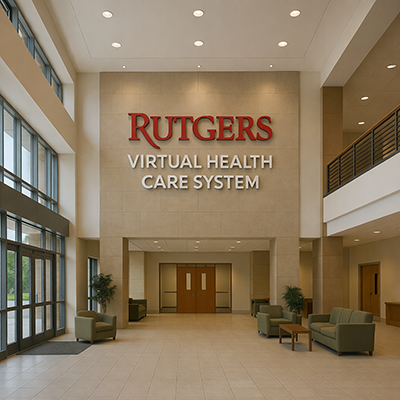
Using AI to Train the Next Generation of Clinicians
Inside Rutgers School of Health Professions’ Emerging Virtual Health Care Simulator Initiative
With just a few words, a clinician can turn a patient’s life upside down.
Mr. Smith, a 65-year-old patient, sits across from the student clinician who delivers the news: “Your biopsy shows pancreatic cancer.” When Mr. Smith hears the word cancer, he falls quiet, looks away, and asks if the results might be wrong.
The next words out of the student clinician’s mouth are crucial, and there is no easy way to have this potentially devastating conversation. But with Mr. Smith, something unusual happens: if the student rushes, talks past the patient’s fear, fumbles their words, or communicates a judgmental perspective, the conversation stops, rewinds, and they get another chance.
Mr. Smith isn’t real, but the skills he demands are. He is just one of many virtual patients inside a growing Rutgers Health Virtual Health Care Simulator (VHS) at Rutgers School of Health Professions (SHP)—a revolutionary digital initiative where faculty, and clinicians can build creative, realistic, patient-focused activities within the context of a health system. This allows students to practice reasoning, communication, and teamwork before stepping into real exam rooms, labs, and community clinics.
A virtual hospital with Newark at its center
The Rutgers SHP Virtual Hospital Simulator is a key component of VHS and the brainchild of SHP faculty member and clinical nutritionist Rebecca Brody, Ph.D. The idea started in a leadership course, where she and colleague Jason Stevens, both from the Department of Clinical and Preventive Nutrition Sciences, created a simulated hospital—complete with administrators, clinicians, and patients—to help graduate nutrition students develop the skills to make complex decisions in high stakes contexts. It worked so well that faculty from other departments began asking if they could build upon it.
Over the summer, Brody rebuilt this virtual hospital into a broader health care system: an AI-powered, virtual health system designed for SHP faculty and students.
“Rutgers SHP Virtual Hospital Simulator is an authentic, urban, simulated hospital with multidisciplinary, multi-scale capabilities,” she told colleagues. “It’s located in Newark, New Jersey, and it is based on the demographics of this area from the 2020 census data.”
It consists of various clinical departments, community sites, and outreach centers. Hospital leaders, clinicians, patients, and students operate the virtual facilities. Each character comes with a brief biography and personality, so that when a student sits down at the computer, they are not just chatting with a generic chatbot; they are meeting a chief medical officer, a dietetic intern, a charge nurse, or a worried parent.
Brody and Stevens also built two custom AI tools: one for faculty and one for students. Faculty, who may have limited experience with AI, are able to use this tool to design activities—case studies, rounds, quality projects, patient interviews, difficult conversations—without starting from scratch every time. The AI prompts them for course goals, settings, characters, draws on course materials for training, and then helps align the activity with competencies while weaving in realistic details from the virtual hospital.
Students then receive the scenarios and enter the student-facing version of the virtual hospital, where the AI stays in character and responds based on the roles and guidance their instructors set. The system is currently being piloted across seven departments, involving fifteen faculty members and hundreds of students through a Canvas course. It also includes a shared repository where activities and lessons learned are collected.
For Brody, the point is a unique combination of novelty and practicality.
“Anything really that you kind of dream up, we can probably make it happen,” she said. The question is what dreams will do the most good.
Using VHS to enhance critical thinking in a larger health care system
For some faculty, VHS is a way to bring hidden work into view.
In Medical Laboratory Science, for example, students rarely interact directly with patients, yet their decisions shape diagnoses every day. Stephanie Cochrane, Ed.D. wanted her advanced hematology students to engage in diagnostic reasoning simulations to understand the thinking that sits behind the numbers—not just the numbers themselves.
“Although we don’t make the final medical decisions, we do have a role in making sure that we are able to interpret data, analyze data, recognize patterns, and also correlate data,” she reminded the audience at a recent research symposium.
In her course, students now enter a virtual hospital as if they are rotating through the hematology section of a typical hospital. Instead of reading a finished case on paper, they treat the AI as if it were a living electronic chart. They request a complete blood count and smear findings, decide what to ask for next, and answer questions about what looks abnormal and why it might matter. Findings arrive gradually, the way they do in practice, and the AI presses them to justify their choices.
The structure is simple—a transcript of the interaction, a summary of key findings, and a short reflection—but the learning is not. Early analysis shows students growing more adept at using professional language and integrating information across lab areas, while also revealing where they need to broaden their thinking beyond a single favored diagnosis.
Crucially, VHS is larger than simply a hospital. In Health Informatics, Lisa Palladino-Kim, Ed.D., uses the same virtual health care system to place students in the middle of clinical research operations. Her learners are not acting as hospital-based clinicians. They navigate a branded, fictional clinical research site and pharmaceutical company, interacting virtually with principal investigators, coordinators, and sponsor staff as they work to understand trial protocols and respond to simulated audit findings.
These scenarios require students to do something a lecture cannot: ask their own questions, probe for context, recognize partial answers, critically evaluate ambiguous information, and propose workable solutions. The virtual environment gives them space to experience those roles before they ever join a real research team.
Practicing the hardest conversations in a safe AI place
Technical reasoning is essential for health care providers involved in direct patient care, but equally important is the human interaction—delivering life-changing news, asking about risky behavior, and inviting someone to change habits that feel deeply personal.
That is where the virtual standardized patients created by Jessica Gomes, D.H.Sc., PA-C, program director for the physician assistant program, and her team come in. They have created characters like Mr. Smith, who is waiting to hear biopsy results, and Mr. Vacco, who needs to talk about diet, sexual health, alcohol use, or drug use—all the topics that make even seasoned clinicians pause.
“They’re a replacement for a standardized patient,” explained Gomes. “We’re utilizing large language models, creating not just a case, but a simulated patient with a realistic personality that allows the student to practice having these difficult conversations in a safe environment.”
Students were skeptical at first. Talking to a chatbot could feel artificial, but the early feedback was striking. Once they tried the simulations, many described relief at having a space where they could stumble, rephrase, and start again without hurting anyone.
What sets these virtual patients apart is that they are not only reactive; they are reflective. At certain points in the conversation, the system shifts into coaching mode, highlighting strengths, and suggesting specific ways to adjust future responses. In one example, it reminded a student that allowing silence after difficult news is not a failure, but a form of respect.
Faculty review these transcripts in Canvas and can step in when they see patterns—both positive and concerning. Over time, Gomes and her colleagues plan to spread these virtual patients throughout the curriculum, so that students encounter them early and often rather than at the end.
Nourishing minds: when food, mood, and AI meet
The same logic—practice the hard conversations in a safe, structured space—sits beneath SunHee Jang Eissenstat’s, Ph.D., “Nourish Your Mind” project, which bridges psychiatric rehabilitation and nutrition.
On paper, the case is well known: people living with serious mental illness, including major depression, often face high rates of obesity, poor diet quality, and food insecurity. Making and cooking healthy meals is hard for anyone; it becomes daunting when symptoms drain energy, access to fresh food is limited, and cheap, processed options are the only ones covered by assistance programs.
In practice, though, this knowledge can fall through the cracks. Mental health counselors worry about stepping out of their lane into “nutrition.” Nutritionists and dietitians may feel unprepared to handle depression and its social and emotional weight. As Eissenstat put it, “There is a gap… we just feel afraid to step into other professions’ fields, and so we just leave that behind.”
Nourish Your Mind is a training pathway designed to close that gap. Participants learn about the links between diet and mood, the realities of food insecurity, and about the evidence for motivational interviewing in this population. They then practice counseling skills with AI-driven “client avatars” who sound and react like real people, complete with hesitation, ambivalence, and small steps forward.
The AI here functions as an always-available rehearsal partner. Learners can ask it to rewind to a moment they mishandled and try again. They can log in from their phones between appointments or during a commute and run one more scenario.
The team is now expanding enrollment and planning to look not just at clinician confidence, but at client outcomes as well.
A shared engine behind the innovation
What ties all of these efforts together is not only the technology, but SHP culture that produced the VHS. It is a culture and a commitment to thoughtfully integrate cutting edge technology to enhance student knowledge and skill—which ultimately leads to optimal patient care.
In his introduction to the Scholarship of Teaching and Learning session at a recent symposium, Scott Parrott, Ph.D., highlighted that VHS is the product of one of SHP’s four faculty writing labs. These labs serve as hot boxes of ideas, peer learning, mentoring, and faculty scholarship. Supported by SHP’s Methodology and Statistics Support Team, these interdisciplinary labs foster faculty creativity, learning, and scholarship in teaching and learning, interprofessional education and practice, health disparities, and SHP’s system of free clinics.
The virtual hospital, the diagnostic reasoning simulations, the virtual standardized patients, the AI counseling partners are all products of that shared, cross-departmental work and vision—built by faculty who are not only clinical specialists, but who also share a deep passion for educational excellence, scientific rigor, and optimal patient care. Currently, Parrott is driving VHS to become Rutgers’ first Core Collaborative Hub for Virtual Health Care Simulation, building a solid foundation for a community of practice, innovation, and impact.
Why it matters
On the surface, this is a story about AI and simulation. Look closer, however, and it is a story about preparation and trust.
Health professionals are asked to hold an extraordinary mix of skills: to interpret complex data, navigate systems, respond ethically and compassionately under pressure, and have conversations that may be the hardest a person ever hears. Traditionally, much of that learning has happened in real time, with real patients. SHP is working to add another layer: a rich virtual health system where students and clinicians can practice and learn before meeting patients.
For someone browsing the SHP site—whether they are considering a program, collaborating from another institution, or simply curious about cutting edge healthcare education—the message is straightforward. Rutgers is not just talking about innovation; its faculty are building practical tools that help students think critically, make life-altering decisions, and navigate difficult conversations more skillfully before they face them when it counts most.
Rutgers VHS may be simulated, but as Brody points out, the confidence, judgment, and empathy that learners carry out of it are very real.