THROUGH THEIR EYES:
Newark Mothers Explore Food
Inequity Using Photography
When a Newark mother used a wheelchair to lower herself to her child’s eye level in the grocery store, what she saw startled her: row after row of ultra-processed snacks, sugary cereals, and brightly colored drinks—all within easy reach of a preschooler. “I couldn’t believe how everything was designed to target them,” she said.
That moment was sparked by a partnership between Rutgers School of Health Professions (SHP) and a Newark Head Start agency using Photovoice—a participatory research method that empowers community members to document issues in their daily lives through photography. The project’s goal was not just to study food insecurity, but to help families in underserved areas question the systems that shape how and what their children eat.
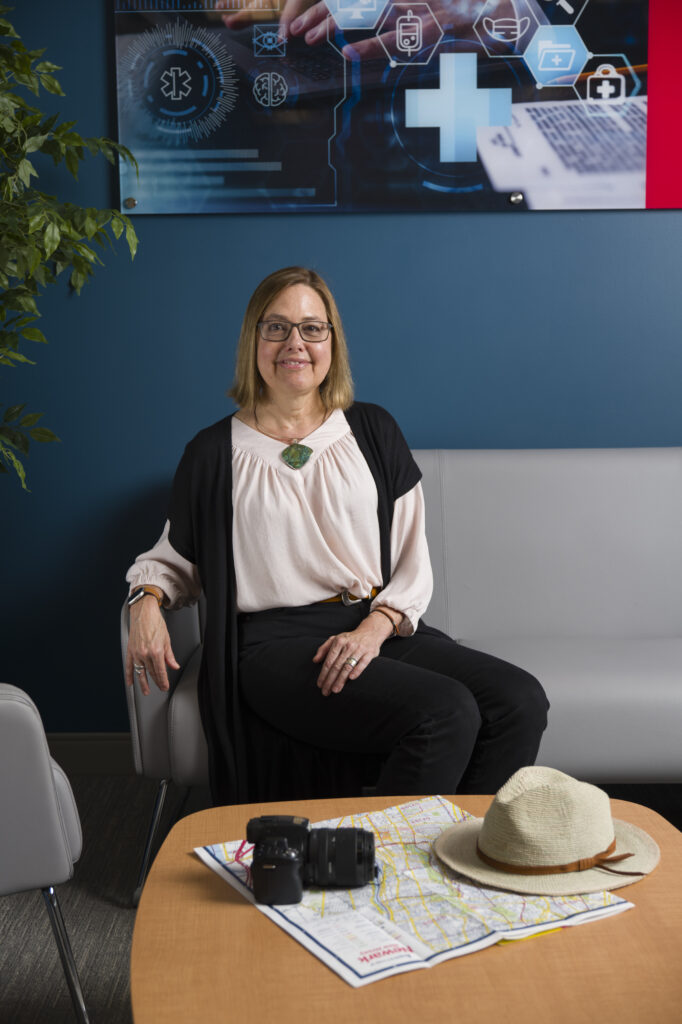
“As a culture, we bombard low-income communities with advertisements for fast food and ultra-processed food,” said Pamela Rothpletz-Puglia, professor in preventive nutrition science and qualitative methods researcher. “This was about engaging people as experts in their own lives and helping them critically examine their food environments.”
The project was funded by a Rutgers Equity Alliance for Community Health (REACH) grant to pilot- test approaches for building community-participatory food justice movements.
Over four weeks, thirty mostly Black mothers, including recent immigrants from African countries, were given cameras and asked to capture images of the food environments that influenced how they fed their children—at home, in stores, and in restaurants. In total, they took more than 800 photographs.
The images became a conversation starter in focus groups, where mothers explained why they took particular photos and what they represented. “At first, the conversations were about price and feeding kids on a tight budget,” said Rothpletz-Puglia. “But over time, they started questioning why things were the way they were—why healthy food is so hard to get, and why unhealthy food is everywhere.”
The project revealed deeper structural barriers. While the mothers appreciated WIC, they noticed that the assigned stores didn’t always carry fresh produce. They described the difficulty of getting to better- stocked stores on public transit. They shared that it was easier to shop in neighborhood stores such as Afro-Caribbean markets, where there are fewer ads targeting children, or local fish markets for fresher food. But those stores were often more expensive.
“These parents want to make healthy choices, but financial constraints and the surrounding food environment make it extremely difficult,” said Rothpletz-Puglia. “Sometimes buying a less expensive treat, like a candy bar a child wants in the grocery checkout, may be one of the few times a parent can say ‘yes.’”
The project also pushed back on a larger cultural assumption: that children should eat differently from adults. “We have this idea that kids need ‘kid food’—chicken nuggets, pizza and ultra-processed food filled with sugar, fat and sodium—but they don’t,” she said. “They can eat the same healthy food we eat.”
In December 2024, Rutgers and the Leaguer’s Inc. Head Start early education agency held a public exhibit of the mothers’ photos and voices. More than 70 people attended, including parents, local business owners, and community leaders. One mother, featured in a five-minute video, described how the experience prompted her to rethink how she feeds her family.
Still, Rothplez-Puglia emphasized that behavior change wasn’t the project’s primary goal—rather than aiming to convince parents to say “no” to unhealthy foods, it was meant to create awareness about the food environment and develop critical consumers and change agents.
The exhibit is now traveling across the Leaguer’s Inc.’s 11 Head Start centers in Newark, Irvington, Roselle, and Elizabeth, continuing to raise awareness. With additional funding, Rothplez-Puglia hopes to build on the momentum to support advocacy and community-driven change.
“We feed our kids based on what’s available, affordable, and advertised to them,” she said. “These mothers started asking why there is so much unhealthy food and advertising to children—and that’s where real change in communities begins.”