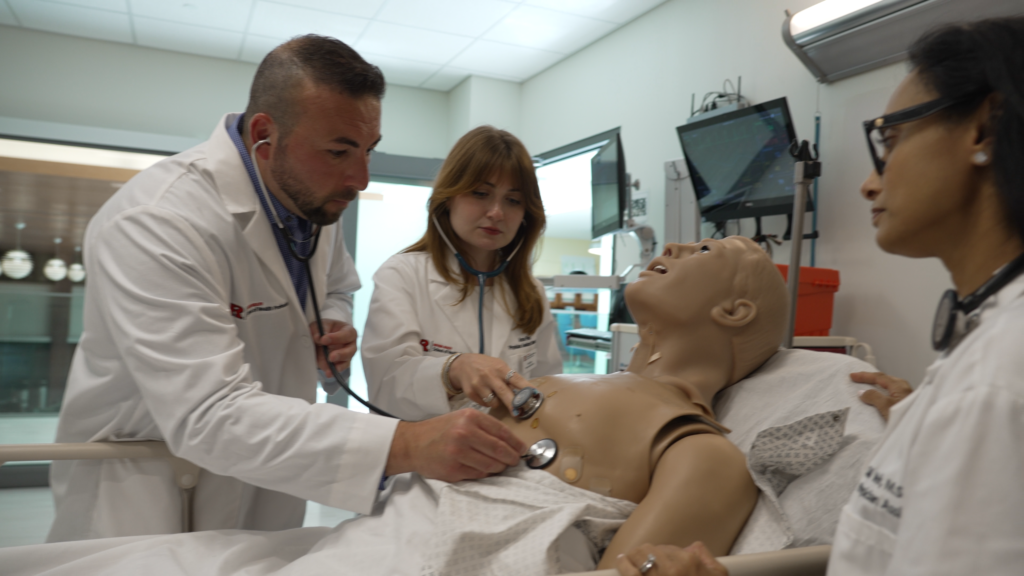
Today, our program is a nationally ranked powerhouse, producing top-tier PAs who shape health care in New Jersey and beyond.
Ranked among the nation’s Top Ten by U.S. News & World Report, our PA program admits just 3 percent of applicants. But the journey wasn’t easy. While other states licensed PAs as early as the 1970s to address physician shortages, New Jersey held out until 1992— after a march on the statehouse attended by faculty and graduates who fought to push legislation through.
Today, PAs are essential to primary care, and our graduates make their mark across public health and enjoy prestigious careers—one even cared for Hillary Clinton when she was secretary of state, according to Department Chair Matthew McQuillan. The program boasts a 99 percent first-time pass rate on the Physician Assistant National Certifying Examination (PANCE), the second highest among U.S. News’s top 20 programs.
But for McQuillan, the program’s culture and emphasis on humanistic care matter most. “Our students apply for many reasons—our history, exceptional pass rates, and dedicated faculty—but they also connect with our mission and the supportive community they hear about from alumni,” he said.
Over the past decade, the department shifted the admissions process to value life experiences alongside academic achievements. Since shifting to holistic admissions —and earning a national award for the effort in 2018 —the program has attracted students from all walks of life. Among them: an Olympic Trials long jumper, a former stand-up comedian, and a musician who pivoted to health care.
Â
“We believe strongly that a diverse workforce leads to better patient care,” said Lori Palfreyman, the former program director who led the change and who retired in the spring of 2025. “People are more than just a GPA, and we’ve seen the proof of that over and over again”
Behind our program successes are faculty whose dedication and scholarship have helped propel it to national prominence.
As of 2024, every full-time faculty member holds a doctoral degree, bringing a wealth of expertise that ensures the program’s continued excellence. Faculty members have earned state and national recognition for their leadership, teaching, research, and innovation.
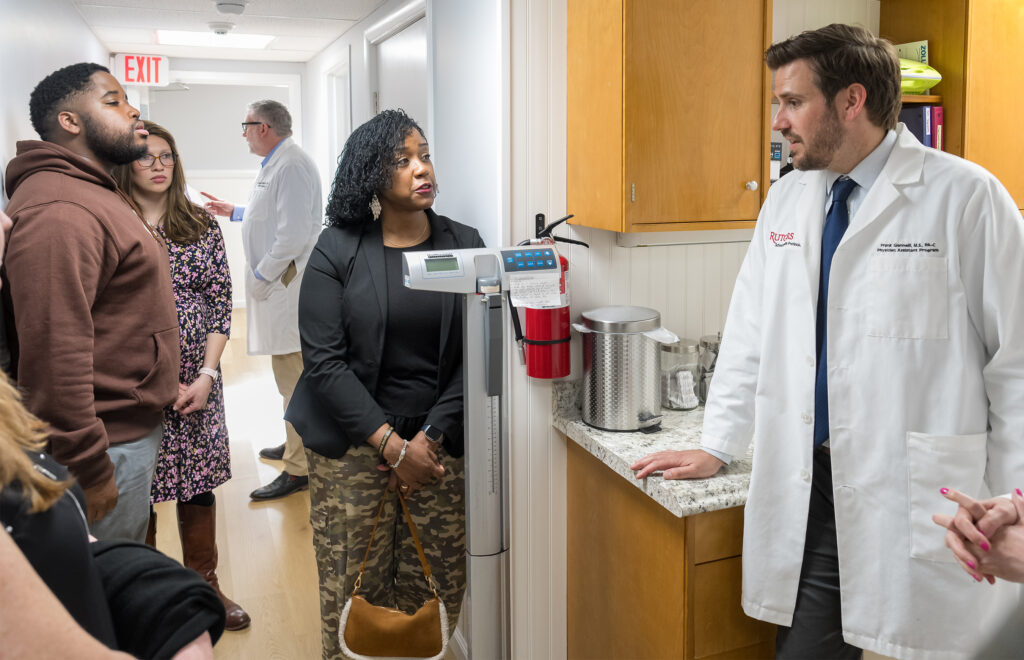
A cornerstone of our program’s commitment to service is the Health Outreach Practice Experience (HOPE) clinic, which provides free care to uninsured and underinsured patients in Plainfield, N.J. For years, Rutgers PA students and faculty collaborated with other organizations to support the clinic, but after the pandemic, the program took full ownership.
Last year alone, faculty, staff, and supervised students logged a record-breaking 700 patient visits. Beyond honing their clinical skills, students gain firsthand insight into health care disparities—sparking a desire to bring about change.Â
“The work we do at HOPE clinic is about more than just providing care—it’s about building trust, understanding systemic barriers, and training future providers who will make a real difference,” Palfreyman said.
That spirit of service extends beyond the clinic. In a testament to the program’s mission-driven culture, three students from the Class of 2021 received full scholarships from the National Health Service Corps in exchange for a commitment to work in underserved areas for at least two years after graduation. And the tradition continues – every year since, at least one student has received the prestigious award.
“It’s an incredibly competitive scholarship, and having recipients year after year speaks volumes about the dedication and caliber of our students,” said Palfreyman.
Our PA graduates are visible in all aspects of health care. Beyond providing patient care, some serve in public health leadership roles, while others innovate new ways to improve patient outcomes.
Recognizing that strong aftercare reduces hospital readmissions, two alumni recently launched a virtual support service that provides round-the-clock check-ins to aid recovery.
“Our graduates aren’t just excelling in their careers—they’re reshaping the future of care,” said McQuillan.
Fifty years in, Rutgers SHP’s PA program isn’t just surviving—it’s thriving.